Meme coin trading with a $10 bankroll works better than waiting for a big account because fees stay small and every mistake is cheap
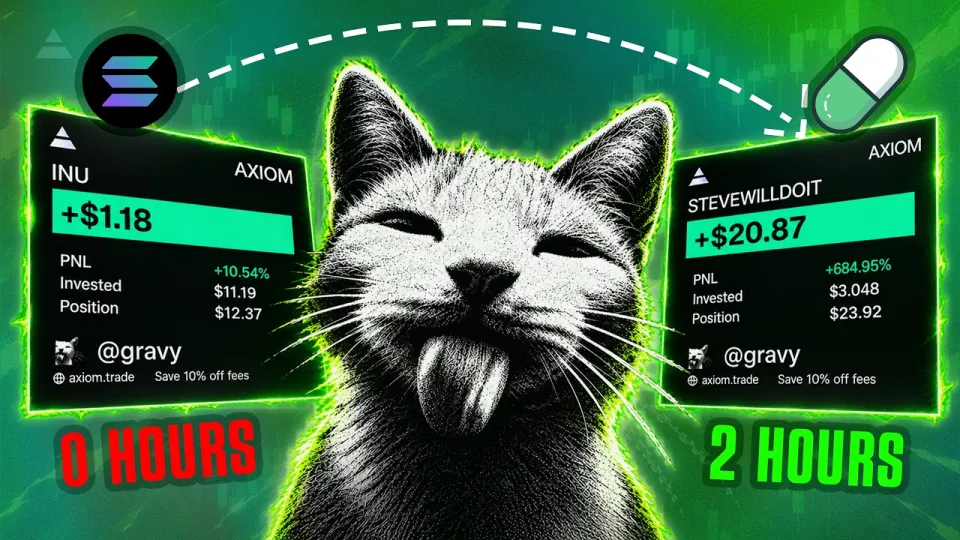
Video: I Tried Trading Memecoins with Just $10
Need articles like this for your video? They help promote it on YouTube and Google — order them in the Telegram bot @sat_sit_bot. The bot writes and publishes the articles itself (with your YouTube video embedded) on popular topical websites (no ads). Try it free: 50 articles on us.
Meme coin trading with a $10 bankroll is viable, but only if you treat fees and slippage as a fixed tax on every position and keep each buy under roughly 0.05 SOL. The small-account approach that actually survives is fewer, narrative-driven trades executed through a low-fee terminal such as Axiom, where the referral gives 2x cashback and 15% lower fees, rather than spraying dozens of micro-buys across random launches.
The channel gravy put that thesis to a real test in the video "I Tried Trading Memecoins with Just $10": five trades, every entry capped at 0.05 SOL, with the reasoning behind each buy and sell laid out. What follows is the practical version — the fee math, the narrative logic and the failure modes that decide whether a tiny portfolio compounds or bleeds out.
Why a $10 meme coin portfolio is not automatically dead on arrival
A small bankroll dies from friction, not from bad luck, so the first job is measuring friction precisely. On Solana, a swap involves a network fee, a priority fee and a platform fee; on a typical aggregator or trading terminal the platform cut is in the range of 0.5–1% per side, and priority fees on a busy launch can add a few cents per transaction regardless of size.
Run the numbers on a $10 account split into five $2 positions:
- Round trip platform fees at roughly 1% per side cost about 2% of the position — four cents on $2.
- Priority and network fees are flat, so on a $2 trade they can easily be another 2–5% of the position.
- Slippage on a thin new pair adds whatever the curve gives you, sometimes several percent in each direction.
That means a $2 position needs something like a 10% move just to break even after costs. The conclusion is not that small accounts cannot trade — it is that they must aim for moves of 50–200%, not 15%, and must not churn. A terminal that rebates part of the fee, like the Axiom referral above, changes the math at the margin, which matters far more at $10 than at $10,000.
The five trades and what each one was really testing
Each of the five positions in the gravy experiment was a different hypothesis about where attention would flow next, and none of them was a blind buy off a trending list. The buys stayed at or below 0.05 SOL, and the review covers why each was entered, why it was exited, and which one was mishandled.
- STEVEWILLDOIT — a play on the X Money narrative, the meta the video spends time unpacking. The reasoning: a payments narrative with recognizable names behind it (the e/acc and Cream crowd) tends to pull retail attention and liquidity toward tickers that reference it.
- NPC — a pure culture/meme ticker, the kind of coin whose price depends almost entirely on whether the joke travels beyond its first buyers.
- MET (Meteora) — a bet tied to a real protocol name rather than a joke, which changes the holder base and the speed at which the trade has to work.
- PUMPY the Trader — a character-driven launch, the category where a recognizable mascot can carry a chart further than fundamentals would justify.
- UNTXD — the trade the creator admits fumbling badly, which is the most instructive of the five: entry timing and exit discipline matter more than the thesis.
How narrative timing decides the outcome more than the ticker
The edge in meme coins is not finding a coin, it is being early to a story other people will retell. A narrative is a reason to buy that survives being said out loud in one sentence — a payments product, a culture war, a named protocol, a mascot. When that sentence is already everywhere, the move has usually happened.
The X Money angle is the clearest example in the video: the meta ran because a specific group of influential accounts pushed it, and coins referencing it moved as attention arrived. That is a repeatable pattern, not a secret. Practically, it means:
- Track a small list of accounts that reliably start metas rather than reacting to them.
- Map each new meta to the tickers that reference it within the first hours, not days.
- Check liquidity and holder distribution before entry — a great narrative on a bundled launch is still a loss.
- Decide the exit before buying: a target multiple, or a hard invalidation level.
A viewer's complaint captures the failure mode exactly: by the time you notice the narrative, buy the dip and wait, the earlier buyers are selling into you, and the coin runs after you take a 20–40% loss. The fix is not more screen time — it is a written plan per trade and a rule that you do not re-enter a coin you were stopped out of without a new reason.
Fees, slippage and the mechanics of a 0.05 SOL buy
Every meme coin trade on Solana is a stack of costs paid before the chart even moves. Understanding the stack is what separates a $10 account that grows from one that quietly goes to zero over thirty transactions.
- Network fee: a flat, tiny charge per transaction, identical whether you trade $2 or $2,000.
- Priority fee: the bid for block space; it spikes during launches and is the main hidden cost on micro-trades.
- Platform fee: the terminal or aggregator cut, typically around 0.5–1%; referral arrangements can cut this by roughly 15% and return cashback.
- Slippage: the gap between quoted and filled price, largest on fresh, thin pairs.
- Price impact: your own order moving the curve on a low-liquidity token.
On a $2 position, the first four can consume a double-digit percentage before the trade has a chance. This is why the video's constraint — never more than 0.05 SOL per buy — is sensible: it concentrates capital into fewer, higher-conviction setups instead of paying fixed costs over and over.
Common questions small-account traders keep asking
Small portfolios generate a specific set of doubts, and most of them come down to process rather than picks. The recurring ones: how to build a feed that surfaces narratives instead of noise, how to size a position when the bankroll is a few dollars, and whether to keep going after a loss.
On the feed problem, the answer is curation over volume: follow the accounts that originate metas, mute the ones that only amplify, and keep a short watchlist per narrative instead of scrolling a timeline. On sizing, the rule is that a single loss should never remove more than one position's worth of capital — with five positions of $2, one total loss costs 20% of the account, which is recoverable; five losses in a row is not. On losses, the honest answer is that a 20–40% stop on a meme coin is often correct, and the pain of watching it run afterwards is the price of not holding a dead chart to zero.
Useful links from the breakdown
- Axiom trading terminal with 2x cashback and 15% lower fees
- Discord — The Trenches: https://discord.gg/W7TqkExcSd
- Discord — free Axiom imports and trade signals (NFA): https://discord.gg/9W5j3XUgYB
- Creator's X profile: https://x.com/gravyski
- Leverage trading with 20% futures fee reduction: https://www.bitbase.com/landing-page/trading-earning-Gra?ref=8CYOGY
What a $10 experiment actually proves
The takeaway from gravy's five-trade test is that a small meme coin account is a discipline exercise, not a lottery ticket: cap each buy near 0.05 SOL, pay attention to the fee stack, and only enter when a narrative gives you a one-sentence reason. One trade was fumbled, and that is the point — the losses are small enough to learn from, which is exactly what a $10 bankroll is for. If you want to run the same experiment with better fee economics, start through Axiom with the referral for 2x cashback and 15% lower fees, and treat every position as tuition rather than a payday. The channel gravy is worth following for more of these transparent, trade-by-trade breakdowns.
Key takeaways
- Five real trades, none larger than 0.05 SOL per buy — roughly a few dollars at typical SOL prices.
- Axiom offers 2x cashback and 15% lower fees through the creator's referral link.
- Trade 1 was STEVEWILLDOIT, tied to the X Money meta pushed by e/acc and Cream.
- Other plays: NPC, MET (Meteora), PUMPY the Trader and UNTXD — one of them was badly fumbled.
- The creator asks viewers whether to live trade a doxxed wallet from 0.1 SOL or 1 SOL.
Questions & answers
Is $10 actually enough to trade meme coins profitably?
It is enough to trade, but the target has to be large moves rather than small scalps. Fixed fees and priority costs eat a double-digit share of a $2 position, so a trade needs a 50%+ move to be worth taking. Treat $10 as tuition for learning execution and narrative timing.
How do I find coins with good narratives without living on X all day?
Curate a short list of accounts that originate metas instead of amplifying them, and check a new narrative against the tickers referencing it within hours. Keep a written thesis of one sentence per trade; if you cannot state it, skip the coin. Volume of scrolling is not the same as quality of information.
Why do I lose 20–40% and then watch the coin run higher after I sell?
That is usually late entry into an already-public narrative, combined with a stop placed where the crowd is. Enter earlier, size so a full loss is survivable, and do not re-enter the same coin without a genuinely new reason. Chasing after a stop is how small accounts bleed out.
Does a referral or cashback link really matter with such a small balance?
Yes, proportionally it matters more than on a large account. A 15% reduction in platform fees plus cashback trims the fixed drag on every micro-trade, which at $10 can be the difference between a break-even experiment and a losing one.
Source: I Tried Trading Memecoins with Just $10 · Markdown version